Your reputation rests on trust
Few businesses carry the same weight of trust as a law firm. Every document, email, and conversation holds the confidence of a client who believes their most confidential information is safe with you. That trust is the foundation of every case, every referral, every reputation built over years.
When that trust is broken — even once — it's not just data that's lost. A single exposed credential, leaked case details, or compromise can trigger investigations, client departures, and headlines that undo decades of credibility.
The problem is, most firms aren't built like security companies. They're small to midsized businesses with dedicated attorneys, not dedicated threat analysts. Their networks may be protected by IT partners or managed service providers — but that doesn't mean they have insights into the dark web, leak sites, or data sources where early warnings appear.
This is the gap between the visibility firms have and the visibility they need — and it's where ThreatHarvest delivers the first real advantage.
Professional Guidance from the American Bar Association
The ABA GPSolo eReport (May 2025) advises firms responding to a breach to use dark-web monitoring tools to check whether cybercriminals have leaked sensitive data. Combined with the profession's duty under Model Rule 1.6 to safeguard client information, this guidance reflects the increasing importance of maintaining awareness of external threats that may impact client confidentiality.
The American Bar Association's recommendation appears within breach-response guidance, but its reasoning supports proactive monitoring as part of ongoing client-data protection. ThreatHarvest is not affiliated with or endorsed by the ABA; this reference is provided for informational purposes only.
How ThreatHarvest Helps Law Firms Protect Trust
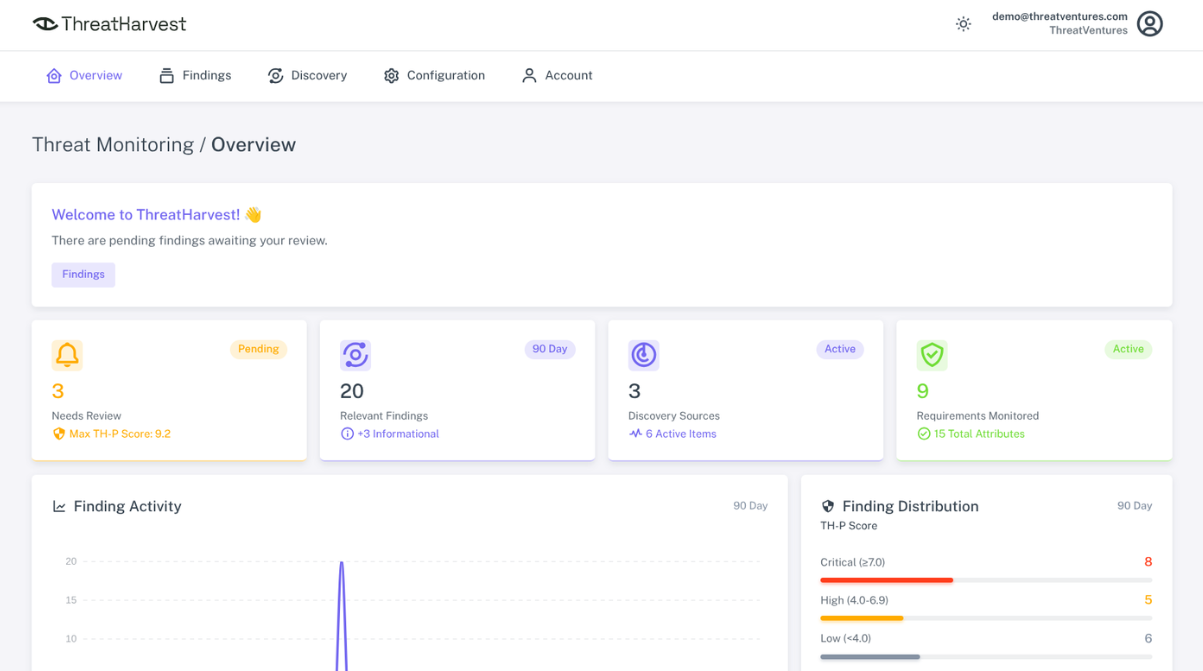
ThreatHarvest monitors the external threat landscape — including the dark web, messaging channels, news media, threat feeds, and more — for signs that your firm has been exposed or is at risk of compromise. Unlike endpoint tools like antivirus or firewalls that protect the internal network, ThreatHarvest watches the outside world — the places where leaked data surfaces, attackers coordinate, and early warning signs emerge before an incident reaches your door.
Credential Leak Detection
Finds exposed staff credentials across breach dumps and underground data sets — identifying compromised logins that attackers can exploit.
Document & Data Leak Monitoring
Monitors dark-web and messaging channels for data-leak claims or shared materials that may involve client or firm information.
Ransomware & Extortion Listings
Tracks ransomware and data-theft groups that threaten to release firm or client information — enabling faster incident response and notification.
Targeting & Exposure Mentions
Detects when your firm appears in underground chatter, helping identify early reconnaissance or targeting.
AI Assessment & Scoring
Findings are automatically analyzed and scored for relevance and impact — reducing noise so attention can be directed to what matters most.
Proof of Due Care
Provides evidence that your firm actively monitors external threats — reinforcing client confidence and demonstrating compliance diligence.
From Exposures to Evidence
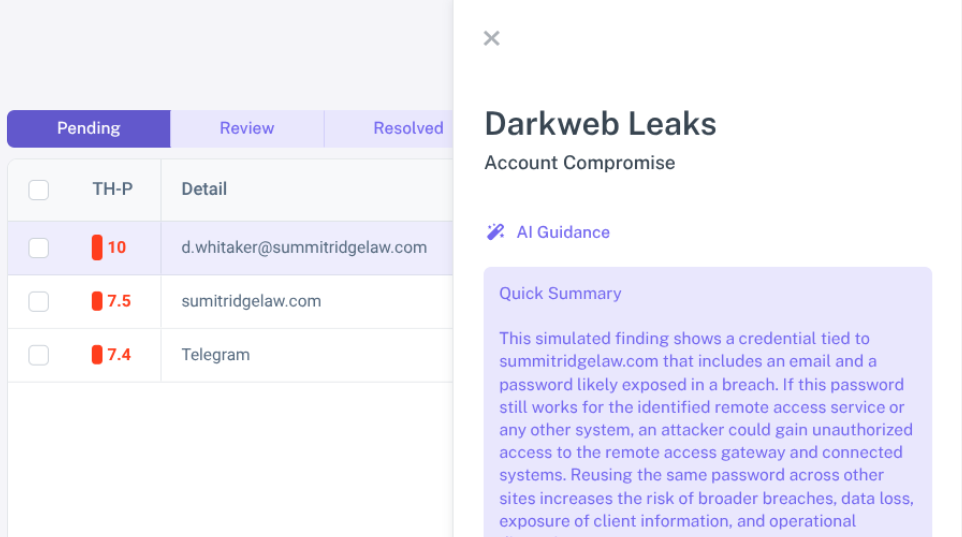
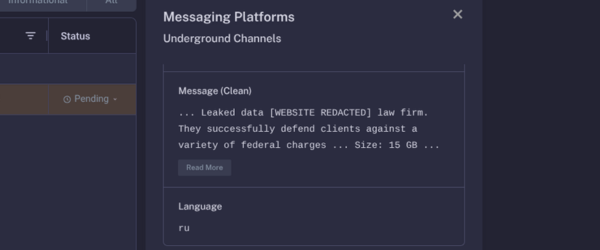
ThreatHarvest turns scattered, external data into clear intelligence. Below is an example of how findings appear when a law firm's data surfaces in the wild — and how the same information looks once processed and prioritized through our system.

Start Protecting Client Confidentiality Today
ThreatHarvest gives law firms early visibility into exposures before they become client-facing crises.
Setup takes under 15 minutes — no security team required.
Starts at $99/month · View pricing · Cancel anytime
Frequently Asked Questions
How does ThreatHarvest detect exposures relevant to a law firm?
ThreatHarvest monitors data from the dark web, breach repositories, and ransomware leak sites, using your firm's attributes (e.g., domains, IP addresses) to identify exposures tied to your practice. Each finding is analyzed and scored for relevance.
Does ThreatHarvest monitor more than data leaks?
Yes. Beyond data exposure, ThreatHarvest also monitors several other key indicators such as emerging vulnerabilities in common practice software, supply-chain breaches that impact legal vendors, and threat feeds that signal potential compromise in your environment. Together, these signals help provide a unified picture of your firm's external risk.
Does using ThreatHarvest require a security team?
No. The platform was built for firms without in-house analysts. It delivers findings in clear, prioritized form so partners, IT providers, or compliance officers can review and act.
How often is new data processed?
Most sources are monitored continuously, with new findings typically surfacing within hours of detection. Higher-frequency sources such as credential repositories and ransomware leak sites are checked most often.
Can ThreatHarvest help demonstrate diligence to clients or insurers?
Yes. ThreatHarvest provides a searchable finding log and audit trail that demonstrates active, ongoing monitoring of external threats. Firms can use this documentation with cyber insurance carriers during renewals and in client security questionnaires. Findings can also be referenced directly in risk-management documentation to show that external threats are being identified and acted upon.